Cash flow
Build a supplier payment schedule before cash gets tight
List each verified unpaid bill, its remaining balance and agreed due date. Place those payments beside expected customer receipts, then check the available cash before each payment. If the plan is short, resolve the gap and document any new agreement before the due date.
Start with verified remaining balances
A payment schedule is a working list of what remains to be paid, when it is due and which cash will fund it. A bill total is not always the outstanding balance: earlier instalments and agreed credits matter.
For each item, keep the supplier name, original invoice reference, remaining balance, due date, evidence and person responsible. Mark an unresolved invoice separately so its status stays visible. Check that a second copy of an invoice has not become a second payable.
Business Victoria recommends documenting agreed supplies, amounts and payment dates. Use that general management principle here; its Australian payment-code provisions are outside this Indonesian example.
Read the register consistently
Use Rp0 only when you have checked that nothing is due or paid in that field. A blank means unknown or not applicable; explain which. A missing due date needs confirmation, not an invented date. An unpaid bill is overdue only after its agreed due date has passed. Keep disputed amounts visible in an exception list while you confirm what is payable.
Hypothetical unpaid-bill register
The following figures are hypothetical, not a FluxyOS customer story. All dates are in 2026. All three obligations are verified. There are no disputed amounts, extra fees or tax calculations in this simplified example.
| Obligation | Invoice total | Already paid | Remaining | Due date |
|---|---|---|---|---|
| Packaging invoice PK-01 | Rp4.000.000 | Rp1.000.000 | Rp3.000.000 | 26 October |
| Supplier invoice SP-02 | Rp7.000.000 | Rp0 | Rp7.000.000 | 29 October |
| Premises rent RT-03 | Rp5.000.000 | Rp0 | Rp5.000.000 | 30 October |
| Total | Rp16.000.000 | Rp1.000.000 | Rp15.000.000 | Not applicable |
The register uses Rp15.000.000, not Rp16.000.000, as the remaining cash requirement. Keep payment evidence with the original invoice in your daily bookkeeping records.
Put cash receipts and payments on actual dates
Assume the business has Rp12.000.000 of reconciled, available cash before the first payment. A customer is expected to pay Rp8.000.000 on 28 October. That receipt is an estimate until it reaches the account.
Use the cash roll-forward described in business.gov.au guidance: opening cash plus receipts minus payments gives closing cash. Carry each balance into the next date.
| Date | Receipt | Payment | Cash after the movement |
|---|---|---|---|
| 26 October | Rp0 | Rp3.000.000 | Rp9.000.000 |
| 28 October | Rp8.000.000 expected | Rp0 | Rp17.000.000 |
| 29 October | Rp0 | Rp7.000.000 | Rp10.000.000 |
| 30 October | Rp0 | Rp5.000.000 | Rp5.000.000 |
The week ends at Rp12.000.000 + Rp8.000.000 − Rp15.000.000 = Rp5.000.000. This assumes the receipt arrives before the later payments and there are no other movements. For your real plan, include wages, other bills and committed spending; exclude restricted funds from opening available cash. If receipts and payments share a date, check bank cut-off times and which movement clears first. A positive month-end total does not prove that every earlier payment date is funded.
Test the expected receipt arriving late
Move the Rp8.000.000 receipt into the next week. After the first Rp3.000.000 payment, cash is Rp9.000.000. Paying Rp7.000.000 on 29 October leaves Rp2.000.000. The next Rp5.000.000 payment then has Rp3.000.000 without funding.
This is a warning in the plan, not evidence of an available bank overdraft. Do not treat a customer's promise as cleared cash.
Suppose the owner also chooses a Rp4.000.000 minimum cash target for other daily needs. This is a scenario assumption, not a recommended reserve for every business. The late-receipt case needs Rp7.000.000 more cash, or appropriate agreed changes, to pay everything and retain that target: Rp3.000.000 to cover the funding gap plus Rp4.000.000 to preserve the target.
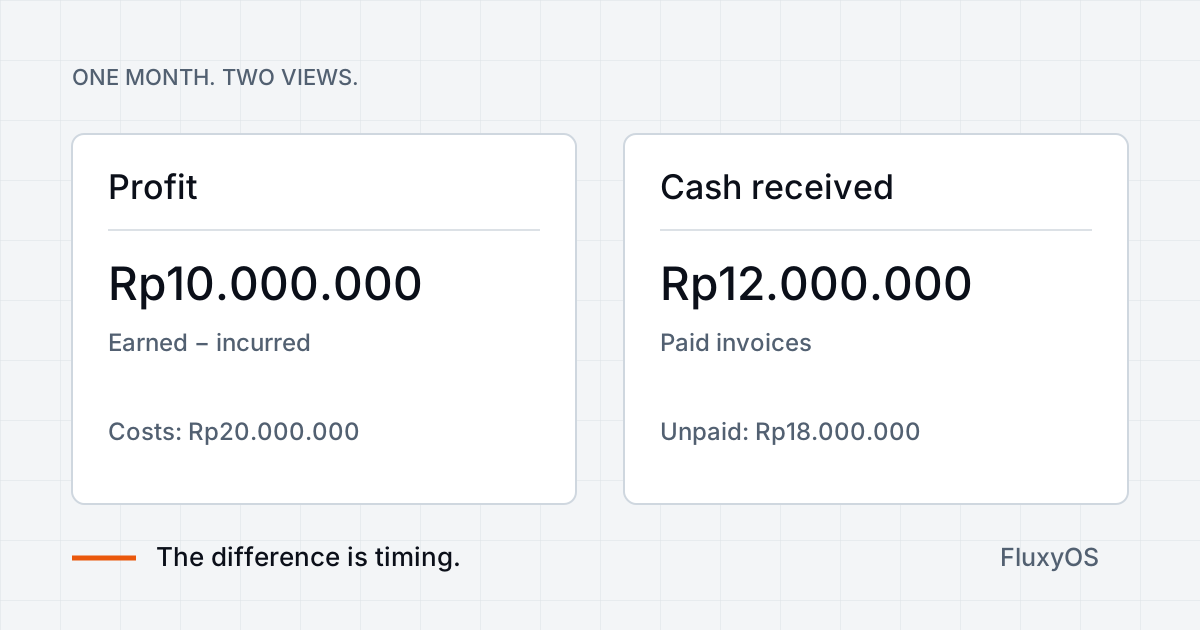
Keep the base case and late case together. The owner can then see exactly which assumption changed. Cash available for a bill and accounting profit answer different questions; fund this schedule with available cash.
Resolve the gap with a named action
Before the affected payment date:
- Ask the customer for a realistic receipt date and update the evidence behind the estimate.
- Check whether any other available cash has been omitted or counted twice.
- Discuss an affordable revised payment date or instalment with the supplier, if needed. Record the actual agreement; moving a spreadsheet date does not change the original terms.
- Assign a person and a follow-up date to each unresolved item.
Record an actual partial payment against the original balance. Keep its reference and the remaining obligation visible. Do not mark the whole invoice paid because one instalment has left the account.
Avoid solving a cash-plan difference by changing an accounting balance without evidence. If the statement and records disagree, use the bank reconciliation example to investigate first.
Copy this action log
These are hypothetical assignments and completion tests, not completed actions. Keep the original due dates until a new agreement is confirmed.
| Action | Owner | Evidence needed | Review by | Complete when |
|---|---|---|---|---|
| Confirm customer receipt | Owner | Customer confirmation and bank entry | 27 October | Receipt date checked; replace estimate only after cash arrives |
| Discuss SP-02 timing if needed | Finance lead | Written supplier agreement | 28 October | Agreed terms and cash plan both updated |
| Resolve RT-03 funding | Owner | Verified funds or agreed revised terms | 29 October | Payment and chosen cash target are funded |
Review the schedule before the next payment run
Replace estimates with actual receipts and payments, check the next due dates, and retain the version used for the decision. A useful action note says: “Customer receipt delayed; owner will confirm date before Thursday's supplier payment.” It does not merely say “cash flow issue”.
Keep these checks beside the plan:
- Is each amount a verified remaining balance?
- Is the date the agreed due date or an explicitly labelled proposal?
- Has the expected receipt arrived before the payment needs funding?
- Does each unresolved difference have evidence, an owner and a next step?
This is a manual planning worksheet. FluxyOS can record bill payments and remaining balances; recording a payment does not transfer money to a supplier. Keep this dated cash plan separately and refresh it before the next payment run. For an overview of the product, explore FluxyOS.
Sources & further context
Source links checked on 26 October 2026. Examples and checklists are original FluxyOS explanations.