Cash flow
Cash flow vs profit: why the bank balance feels different
Profit measures revenue earned minus expenses incurred over a period. Cash flow measures money actually received and paid. An unpaid customer invoice can increase accrual profit before it adds any cash to your bank account.
Two numbers, two different questions
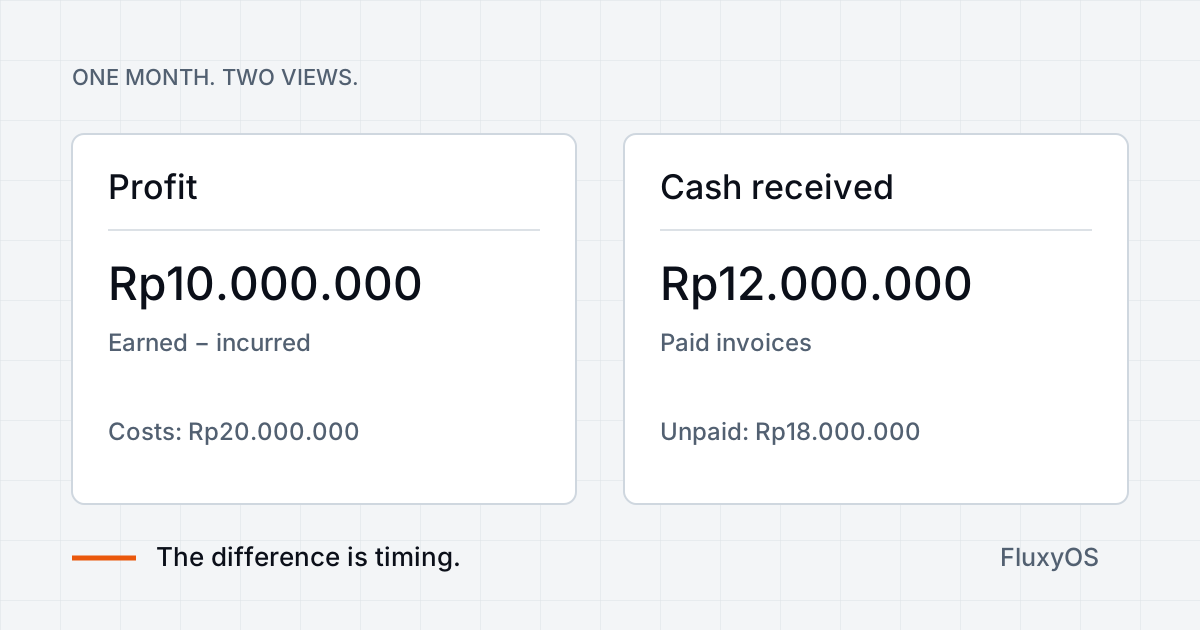
Profit asks whether the work earned more than it cost. Cash flow asks whether money arrived before payments had to leave. An Indonesian agency can finish a campaign this month, pay its freelancers now, and collect the client invoice next month. The work and the payment sit on different dates.
This guide uses a simplified accrual example: revenue is earned when the service is completed. Your accounting basis matters when comparing profit with receipts. The IFRS Foundation’s IAS 7 overview explains that reconciling profit to operating cash flow involves non-cash items and timing adjustments. It is a reference for the distinction, not a statement that every Indonesian business must use IFRS.
A worked example: an agency’s month
Consider a hypothetical agency with opening cash of Rp10.000.000. It completes Rp30.000.000 of services, collects Rp12.000.000 of those invoices, and incurs and pays Rp20.000.000 of operating expenses. Assume no opening receivables, debt, tax, depreciation or other transactions.
| Item | Accrual profit view | Cash movement |
|---|---|---|
| Completed services | Rp30.000.000 | Rp12.000.000 received |
| Operating expenses | Rp20.000.000 | Rp20.000.000 paid |
| Result | Rp10.000.000 profit | Rp8.000.000 net cash outflow |
Closing cash is Rp10.000.000 + Rp12.000.000 − Rp20.000.000 = Rp2.000.000. The unpaid Rp18.000.000 is a receivable, not cash available today. The opening balance is also not revenue. All figures here are teaching assumptions, not a customer result.
Look for the timing gap
For an online shop, distinguish an order from the date a marketplace payout reaches the bank. For a service business, distinguish an invoice from its payment. When reviewing expenses, keep an unpaid supplier bill separate from the later bank payment that settles it.
Other movements need their own explanation. A loan receipt raises cash without being sales revenue. Repaying loan principal reduces cash without being an operating expense. Buying equipment can use cash before its cost is recognised through depreciation. A transfer between two of your own business accounts changes their individual balances but not total business cash.
A weekly cash check you can actually use
- Start with the reconciled cash and bank balances for one date.
- List customer amounts due, with expected collection dates. Flag uncertain collections separately.
- List supplier bills and other payments by due date. Separate commitments from payments already made.
- Calculate a manual next-week estimate: opening cash + expected receipts − expected payments.
- Compare the estimate with actual movements next week and explain the difference.
The cash-flow worksheet from business.gov.au uses the same closing-balance arithmetic. Use its general planning approach; Australian tax instructions do not establish Indonesian obligations. Avoid treating an optimistic collection date as a confirmed receipt.
Turn the explanation into a routine
If the cash gap comes from late invoices, review collection dates before adding more spending. If the problem is spending commitments, build a monthly operating budget. If balances are hard to explain, start with the daily bookkeeping checklist.
FluxyOS lets you create customer invoices and record payments. Explore FluxyOS Invoice to see that workflow. A recorded invoice or payment status still needs to match the underlying evidence; creating an invoice does not put money in the bank.
Sources & further context
Source links checked on 19 October 2026. Examples and checklists are original FluxyOS explanations.